
Longitudinal Modeling
Study how imaging-derived anatomy and biological characteristics evolve across time points where appropriate data are available.
Human brain digital twins
SpinField Labs is exploring imaging-informed computational representations of brain anatomy and imaging-derived biological information for simulation, longitudinal research, and medical AI.
Definition
A brain digital twin refers to an imaging-informed computational model that can organize anatomy, quantitative information, longitudinal measurements, and model assumptions for research and simulation.
Example digital twin type
This viewer overlays an MRI volume with one selected tissue channel from a phantom volume so you can inspect how CSF, gray matter, or white matter aligns with the same anatomical slices.
Interactive 3D Phantom
Loading volumes…
Example computational phantom
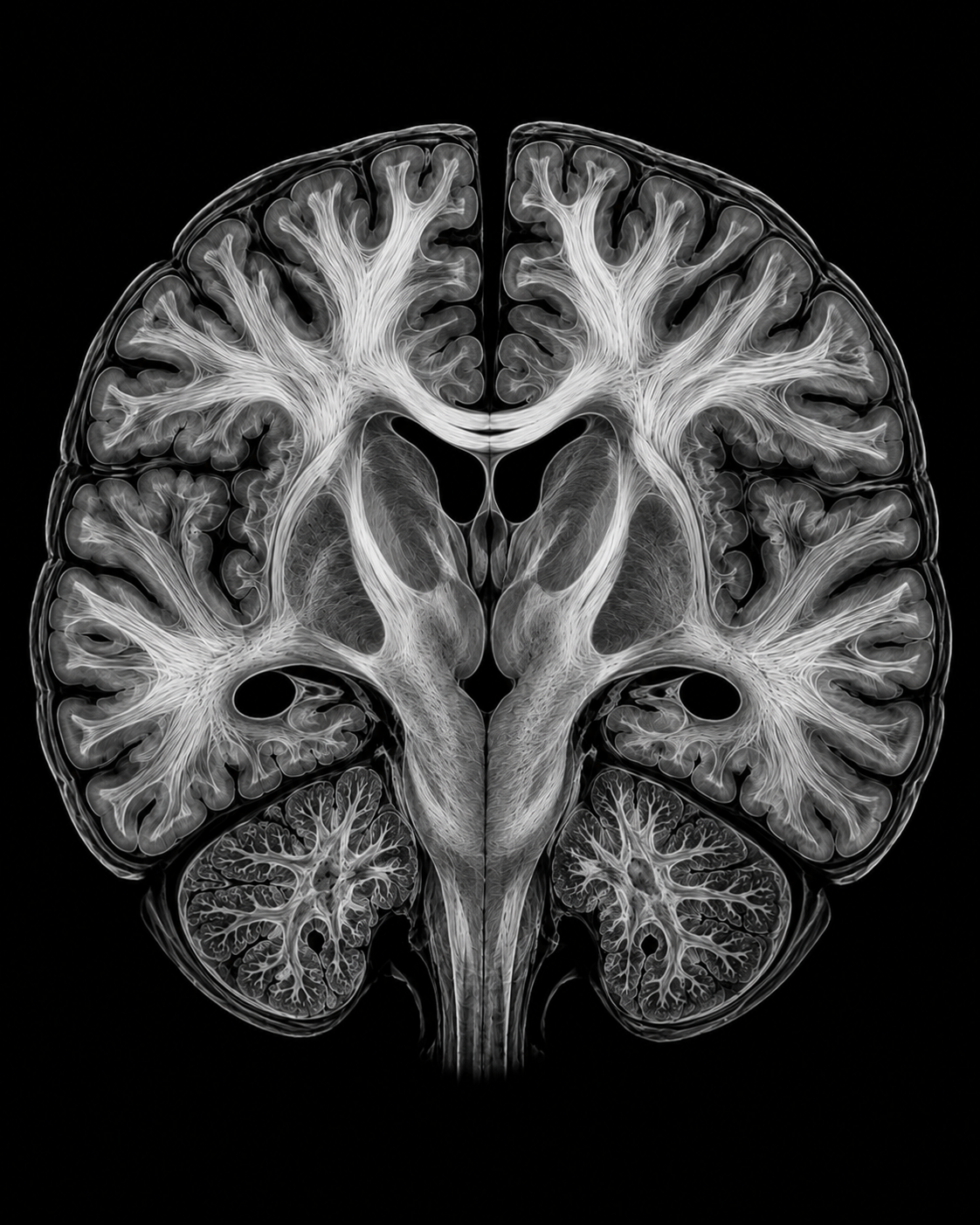
Diffusion-inspired computational phantoms can represent organized white-matter pathways and microstructural structure for simulation and algorithm research.
This is not a clinically validated patient model.
Research opportunities
These are potential research applications, not claims of validated clinical prediction, treatment recommendation, or deployed surgical planning.
Study how imaging-derived anatomy and biological characteristics evolve across time points where appropriate data are available.
Develop computational models to investigate patterns associated with progression without presenting individual future-course predictions as established clinical capability.
Investigate plausible imaging-derived trajectories for AI development, simulation, and robustness studies.
Use computational models and imaging-derived representations as additional structure for representation learning, multimodal learning, self-supervision, pretraining, and robustness testing.
Explore computational cohorts for research simulation, sensitivity analysis, algorithm development, and hypothesis generation.
Study imaging-derived features and computational representations associated with changes in anatomy or disease.
Investigate how digital twins could support research on procedure simulation, intervention planning, robotic workflows, and potential complication scenarios.
Computational research
Discuss longitudinal imaging, quantitative representations, tractography-informed phantoms, virtual cohorts, biomarker research, simulation, or AI methods built around computational models.